Monday, April 26, 2010

Zone 9 Blueberry Varieties

So, from Raintree, these are my choices for zone 9:


The Chandler Blueberry


It has the longest ripening season of any blueberry, providing more than a month of sweet, firm delicious fruit.

$13.50 / plant


The Elizabeth (no photo)
It's back! Blueberry gourmets have long been trying to find a source of Elizabeth! This variety developed in New Jersey in the 1960's is sought for its superior flavor. $12.50  / plant


Misty Blueberry

Hardiness to 0° F, a very low chilling requirement of only 150 chilling hours and a tolerance for higher pH soils makes this a perfect USDA Zones 7-9 choice. $14.50 / plant

This looks like a good plant for this area.


Reveille


The unique crisp, almost crunchy texture and the outstanding popping flavor make this a must for your blueberry patch. $8.50


Unfortunately, it says they need 600 chilling hours... may be too little for here.


Sharp Blue


If you are in the South, enjoy delicious fresh blueberries year around! Sharpblue is the most adaptable variety in low chill areas. $8.50

 This looks like a good choice for us.


Sunshine


Hardiness to 0 degrees F, a very low chilling requirement of only 150 chilling hours and a tolerance for higher pH soils makes this a perfect choice for gardeners in the Pacific Northwest, the South or in California. One gallon plants. $12.50


Hmmm... looks possible

Blueberry Bushes


A while back, Tammy told me that she'd ordered her blueberry bushes from The Raintree Nursery in Washington. I've been wanting some blueberry bushes for a few years now, especially since my son has demonstrated that he will eat them until he turns blue (or at least his poops do!). I guess she also picked up some bushes at Costco, of all places, and her general notion was that both places have good prices.


Multiple Bushes and Varieties and Know How Many to Buy
What little I know of blueberries is that it's good to mix two varieties for pollination purposes (though I'm unsure why you need different varieties to cross pollinate... wouldn't you end up with a hybrid fruit then?), since they're not self-pollinating.


Pollination: Most fruit trees, including blueberries have both male and female organs on the same flower, but not all are self pollinating.  The best bet for blueberries is to have different varieties of blueberries  within 100 feet, so bees can travel and cross pollinate.  Blueberries cannot be fertilized by their own pollen!
The Blueberry site also notes the importance of choosing varieties that have overlapping seasons, as well as counting on two plants per family member. Here's a good list of seasons and varieties and here's some more info from the blueberry site:
You may want to select varieties that ripen at different times or feature large fruit (best for fresh eating and desserts) or small fruit (best for muffins and pancakes). Bushes with brilliant fall color or different growth habits offer the gardener lots of choices to use throughout the landscape. For blueberry lovers, allow at least two plants per family member.

 Zones, Baby, Zones
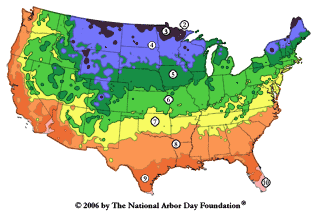
It's also important to make sure you get varieties that do well in your zone. I'm in an odd area, with Northern California's micro-climates having a strong effect, it's hard to know on any given day what the exact climate is. However, using this guide, I was able to guesstimate that we're in zone 9. The guide is great because you can look up your hardiness zone by zipcode.


Coffee and Blueberries?
Another thing Tammy taught me was to keep the soil acidic. She had a whole idea about mixing coffee with the water every now and then, but I'll have to double back with her to see what her exact measurements were.

Sunday, April 25, 2010

Potting Soil Comparisons


I came across this fantastically in-depth potting soil comparison the other day. It's too bad he only used one organic soil, as I'd much rather see how various organic soils fared with one another. Nevertheless, I'm impressed by his thoroughness! Here's his conclusion:

Supersoil's high germination rate and superior growth in both melon and tomato seedlings make it the preferred choice of the potting soils tested. When the additional factors of ease of handling, easy watering, fast drainage and low cost are also considered, it is the clear winner.
Peaceful Valley Farm Supply's potting soil came in a close second. But, the fact that it's four times the price of Supersoil after adding in the cost of shipping and not conveniently available makes it much less desirable. Another downside is that it contained weed seeds that germinated in the sample I tested. This was an annoyance that could be a serious problem for someone whose desired seedlings looked like the germinating weeds. How would he or she know which to remove?
They are many dozens of other potting mixes on the market that I wasn't able to test so this experiment can't be considered definitive. But, it strongly suggests that Supersoil potting soil is a superior product capable satisfying anyone's gardening needs. It's certainly the brand I'll be using in my garden from now on.
 
And here's a final note of warning that he makes about a horrible brand he used the year prior. Funny enough, this is the potting soil that I've been using (not the rose one, but the vegetable one). Yipes!


The year before the above comparison I purchased four bags of Gardener and Bloome's Rose Potting soil and used it to plant 77 pots with zinnia, tomato, melon, Canterbury bell and salvia seeds. The results were a complete disaster. Although I followed my regular routine for growing seedlings, a routine that's worked flawlessly for over 20 years, with this brand of potting soil I only got a 20-percent germination rate, the few plants that came up grew poorly, exhibited many disease symptoms and 30-percent of them died. Upon testing the soil I discovered that in spite of the package advertisements stating that the soil contained a wide spectrum of organic amendments such as bat guano, worm castings, kelp meal, alfalfa meal and so forth, the soil was completely lacking in nitrogen, potassium and phosphorous. Even after adding extra fertilizer the plants grew poorly. I've used many potting mixes over the years and this is clearly the worst. Perhaps I got a bad few bags out of what may otherwise have been a a good production run, but for myself I will never use this product again.

Fertilizing Tomatoes


As I've mentioned before on this blog, I seriously thought you couldn't fertilize vegetables in order for them to be organic. At least, not until this year. Apparently, that's cool. Here's the skinny on organic fertilizers:

In addition to increasing yield and fertilizing plants directly, organic fertilizers can improve the biodiversity (soil life) and long-term productivity of soil, and may prove a large depository for excess carbon dioxide. Organic nutrients increase the abundance of soil organisms by providing organic matter and micronutrients for organisms such as fungal mycorrhiza, (which aid plants in absorbing nutrients), and can drastically reduce external inputs of pesticides, energy and fertilizer, at the cost of decreased yield.
Nifty!

Anywhoo... Seeing as we're going to finally plant our tomatoes next weekend, I thought I'd brush up on Tammy's hints on tomato feeding. I've already been using the E.B. Stone Organics Tomato and Vegetable Food, but looks like I need to get some Dynamite Mater Magic.

Lettuce and Greens Plantings


We finally got our boxes moved to the right spots in our yard today! My husband has been working crazy hours, including late nights and weekends, so it's taken us over a month just to get a few hours together to move the boxes and fill them with the rest of the soil.

As an incentive to get it done, I bought some nice lettuce, basil and giant chard starts, as well as a strawberry plant from the accordian man at the farmer's market and 6 organic starts from the hardware store, all of which we got planted today. Tomorrow, I'm going to follow up by sowing lettuce seeds, as everything I've read suggests planting new lettuce seeds every two weeks.

We still haven't put our tomato plants out yet. There have actually been a few cold nights lately, despite warm days and I don't want to expose them to a serious chill. We will get them out next weekend. I'm hoping in the meantime that Tammy can come over and help me plan where they should go!

So, today's plantings in the lettuce bed were:

6 x romaine lettuce starts
6 x speckled butter lettuce starts
6 x regular lettuce starts
6 x mesclun lettuce starts
6 x arugula starts


We also planted 1 basil start in a little box on the decking and the seven strawberry plants in a strawberry pot on the lower deck.

Here are some pictures - they're not great quality - from my phone - but I wanted to remember the beginning of the bed as a comparison later in the year.

Little romaines and baby giant kale peeking from behind the lavender. 


Speckled lettuces and pinwheel.


Our two little boxes, finally next to each other, rather than perpendicular!

Saturday, April 17, 2010

The Tomato Starts Are Ready

...but we're not planting them this weekend, despite the perfect weather. Why not, you ask? Because we have a special guest this weekend... The lovely Flo!


She is the world's largest dog --- a leonberger. She's ever so sweet, but can wreak havoc on precious starts by just sneezing on them!

The Northern Border Bed


This is where we will be planting tomatoes. We just cleared it of some purple canna and something green. This weekend has been perfect for planting our starts, but we are dogsitting the world's largest dog. Note that the bed is freshly minted on the right side.

Thus, we're waiting until Flo goes to put the plants in.